
A home detail that typically flies under the radar, but offers much more than just decorative flair. For New York and New Jersey homeowners (let’s be honest, this applies to all home owners really), ceiling fans are a smart home addition that not only help keep you cool, but also your wallet intact. Today we want to break down how ceiling fans can affect your home, and what they can and can’t do.
Will a Ceiling Fan Improve the Airflow in Your Home?
A ceiling fan will most certainly help with airflow. Ultimately a fan does not make air, its purpose is to circulate it. As the blades spin, air moves, which in turn makes it feel fresher (this is ceiling fan circulation). Especially helpful in older homes or in large floorpans with tall ceilings. Ceiling fans are able to get rid of stagnant pockets of air and balance temperatures.
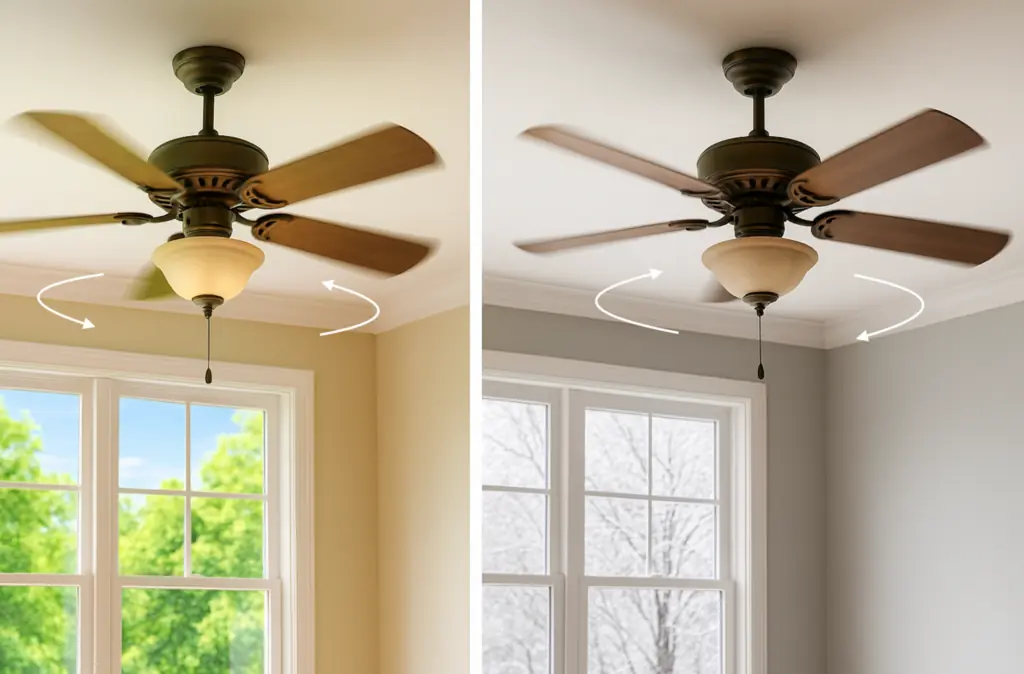
As we’ve mentioned in other blog posts (like this one, for example), for a ceiling fan to properly do its job, it’s important for it to be spinning in the right direction. In the summer, your ceiling fans should be spinning counterclockwise in order to push the cool air down. In the winter, you want to adjust clockwise, in order to redistribute warm air. Most fans are equipped with a switch on the body to change their direction. This is rather important to keep in mind if you want to get the most out of your fan.
Can a Ceiling Fan Make a Room Warmer or Colder?
Alright, this is tricky. In technicality, no. In perception, yes. Ceiling fans do not generate air, they simply move it. The generated breeze in the summer makes the air seem cooler to you (typically by about 4 degrees F), which in turn means you can in theory raise your thermostat a bit and save a few extra dollars. In winter, if your fan is spinning in the right direction, warm air is pushed down, which helps eliminate cold spots, and makes it feel overall warmer. Again, the key is to use the right fan direction for each season.
Do Ceiling Fans Cause More Dust?
Ceiling fans are inanimate objects, so in theory they themselves don’t do anything. What makes a difference, is their surroundings and upkeep. A fan won’t increase pollutants, but it will most certainly distribute those that are already present. Hence if you don’t regularly change your HVAC filters and wipe down your blades, there’s a high possibility for all that built up dust, danger, and allergens to fly around and aggravate allergies. If you take care of your air, for example by using air purifiers and humidifiers, ceiling fans can actually help improve your air quality since they keep the air moving. So remember, a ceiling fan is only as good as the environment it’s in.
Can Ceiling Fans Lower Your Energy Bills?
Absolutely. In simple terms, ceiling fans use a whole lot less electricity than the central AC. Like 40-50 times less. So if you’re wondering “do ceiling fans use a lot of electricity”, no, they don’t. Imagine the kind of impact that can have on your electric bill. By being smart and using your ceiling fans in tandem with your HVAC system, you can reduce both your heating costs in the winter, and your cooling costs in the summer. For NY and NJ, where prices aren’t cheap, this can mean substantial savings.
Conclusion
With our changing climates, rising energy costs, and older housing in New York and New Jersey, adding a ceiling fan may be the upgrade your home needs. Of course as always, there are best practices that you should keep in mind. Pair fans with your HVAC, keep in mind the seasonal direction, and maintain cleanliness. Of course, our team at Green Ductors cares about your air quality. So should you need to perform an HVAC cleaning, or do an air quality test, we’ve got you covered. Our team can be reached at 888-334-1612 and would be glad to answer any questions you may have. Be smart, and have your home work for your comfort and enjoyment.
